Idea Sharing | MetNet3 Fuses Sparse Observation Data to Realize 24-Hour Weather Forecast
Idea Sharing | MetNet3 Fuses Sparse Observation Data to Realize 24-Hour Weather Forecast
Author: Yu Fan Source: Zhihu
1. Background
Accurate predicting the weather for a certain period of time (from minutes to weeks) in the future is a basic scientific challenge. At present, most meteorological services and organizations use traditional numerical weather prediction (NWP). This prediction mode is built based on atmospheric physical models, but is limited by computing costs. Deep Neural Networks (DNNs) provide another paradigm for weather change modeling. Once the model training is complete, the neural networks can predict weather changes in less than one second, with both high time and spatial resolutions. At the same time, AI models can be directly trained through the atmospheric observation data to obtain a closer prediction to observation.
In June 2023, Google Research Institute and DeepMind jointly released the latest weather prediction model MetNet-3. Compared with MetNet and MetNet-2, MetNet-3 improves the weather forecast timeliness from 8 hours or 12 hours to 24 hours, increases forecast variables and expands the forecast range.
2. Method and Experiment
In recent AI weather forecast models, such as Graphcast and Pangu-Weather model, reanalysis data is used as training samples, that is, the data after assimilation through background fields and observations. Compared with these medium-term forecasting models, MetNet-3 introduces some atmospheric observation data for model training and evaluation. However, the observation data differs from the reanalysis data because the source of the observation data varies and is heterogeneous, which has different degrees of sparsity. To fuse atmospheric observation data (sparse data in dots), MetNet-3 uses a method called Densification. Densification directly fuses data assimilation and simulation prediction in the AI model. Figure 1 shows the Densification process.
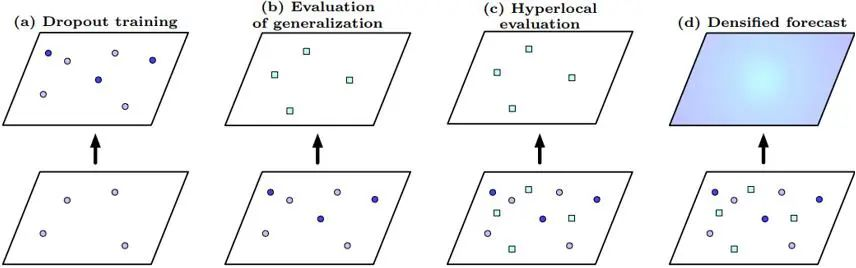
Figure 1 Densification training mode
Densification aims to use site observation data to predict basic meteorological elements at all locations. It selects 80% of all sites as training sites, and 20% as verification sites which do not participate in training and only in precision verification. In actual training, it randomly masks 25% of the sites, outputs meteorological elements of all training sites, and calculates the loss. During the verification, all training sites are input and the precision is verified on all verification sites. In the model inference, the model uses all sites as the input and input the predicted values of all locations.
Figure 2 shows the overall network architecture of MetNet-3. MetNet-3 uses U-Net as the backbone. The dataset contains two resolutions. Therefore, in the U-Net input, the data with the resolution of 4 km is input first, and then the data with the resolution of 8 km is added after one round of DownSample, implementing the fusion of data with two resolutions. Second, MetNet-3 adds the MaxVit module to Unet to capture global information using grid attention. The model has three outputs. At the resolution of 4 km, over 600 assimilation basic elements and sparse site data are output. At the final output layer of the model, the data is UpSampled to the precipitation data of 1 km. It should be noted that although the model outputs the assimilation result as the loss to restrict the entire model, prediction qualities of these elements are not considered in the model evaluation.
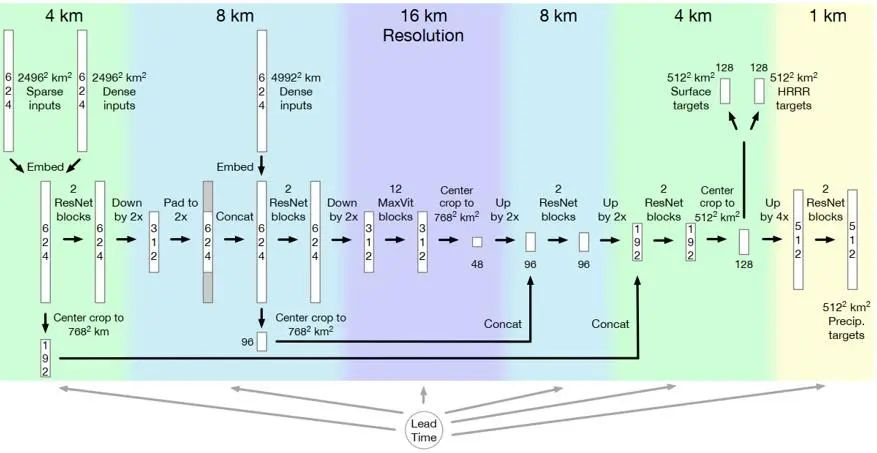
Figure 2 MetNet-3 model architecture
In addition, it is found that if these variables are trained at the same time, trade off exists between the precipitation forecast quality and the forecast quality of other ground elements. Therefore, the training strategy of MetNet-3 is first to reduce the loss weight of OMO to train precipitation elements, and then, increase the weight by 100 times to fine-tune the model.
3. Conclusion
MetNet-3 is a new AI weather forecast model that can forecast core weather variables 24 hours in advance. It outperforms the most advanced numerical models. MetNet-3 is now operational and can generate real-time precipitation forecasts in 12 hours, which is now serving in Google weather products.