
[MindSpore Made Easy] Website User Guide (3) – Resources and Basic Models
MindSpore Made Easy Website User Guide (3) – Resources and Basic Models
MindSpore version: 1.8
Official website: https://www.mindspore.cn/en
This is the third guide on our official website for users. This time, we will focus on the resources and basic models. For previous guides, see:
https://www.mindspore.cn/news/newschildren/en?id=1623
https://www.mindspore.cn/news/newschildren/en?id=1662
You are welcomed to leave your comments below.
Resources

This section provides resources including tools, courses, books, and videos for you to learn on MindSpore.
Noticeably, in version 1.8, we add a new tool MindSpore Dev Toolkit, a development suite for developers. It provides a series of auxiliary functions, such as project management, installation environment improvement, intelligent code completion, intelligent knowledge search, and operator mutual search, comprehensively improving the usability of the MindSpore framework. We also offer other tools, like the operator mapping table and MindConverter. The operator mapping table provides the API mapping information of the PyTorch, TensorFlow, and MindSpore operators, which can help you find alternative solutions to existing network operators to migrate the networks to MindSpore quickly. MindConverter is a model migration tool that can quickly migrate PyTorch (ONNX) or TensorFlow (PB) models to the MindSpore framework. The model file (ONNX/PB) contains the network and weights. After the migration, the model definition script (model.py) and weight file (.ckpt) under the MindSpore framework are generated.
The provided models and samples include the models from ModelZoo and pre-trained models from MindSpore Hub.
ModelZoo provides MindSpore-supported networks that can be directly invoked, including LeNet, LSTM, BERT, and ResNet, avoiding repeated definition and improving development efficiency. You can directly call a typical neural network using import mindspore.model_zoo.xxx.
MindSpore Hub provides trained network model files for typical large-scale networks. You can use the files for model inference, fine-tuning, and transfer learning to save the computing power and time on training.
In the Courses & Certification section, we offer materials, videos, and PDF files on different levels for you to learn. No matter where you are, the courses can be of some help.
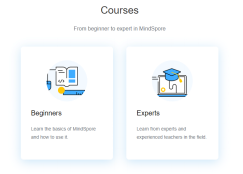
Engineers can also obtain the career certificates of different levels after passing the examination.
Application cases on MindSpore come from enterprises, universities, and developers, describing how MindSpore is applied in problem solving, technology research, and application development. There is a beginner-friendly case about intelligent poem writing for you to try: https://zhuanlan.zhihu.com/p/254937902.
In addition, we are now offering rich bonuses for developers. Besides, many MindSpore competitions are now in progress. If you get familiar with MindSpore, try challenging yourselves by joining them!
Basic Models
We have launched two basic models: PCL-L from Peng Cheng Laboratory and Zidong.Taichu from the Institute of Automation, Chinese Academy of Sciences.
Here's a brief introduction for you:
PCL-L: Industry's first Chinese Natural Language Processing (NLP) model with up to 200 billion parameters. It supports various downstream applications such as knowledge Q&A, retrieval, inference, and reading comprehension. It is the first time to implement large-scale distributed training on a 2048-device computing cluster using the auto-parallel hybrid mode of Peng Cheng Cloud Brain II and the home-grown MindSpore framework. The PCL-L α pre-trained model supports a wide range of scenarios, has outstanding performance in text generation fields such as knowledge Q&A, knowledge retrieval, knowledge inference, and reading comprehension and has strong few-shot learning capabilities.
Zidong.Taichu: Industry's first three-modal pre-trained model with hundreds of billions parameters. It supports efficient collaboration between texts, videos, and voices and empowers industry applications such as film production, industrial quality inspection, and smart driving.
MindSpore aims to natively support basic innovative models and accelerate scientific research innovation and industry application.
MindSpore is updated again to version 1.8 this month, and you are welcomed to explore our new functions. If you have any suggestions, feel free to leave them below.
See you in our next blog!