
Official Release of MindSpore Quantum White Paper!
Official Release of MindSpore Quantum White Paper!
With the rapid advancement of quantum computing technologies, the design and implementation of quantum computing frameworks have become crucial. MindSpore Quantum, an innovative open-source hybrid quantum-classical framework launched by the MindSpore community, is at the forefront of this evolution. Seamlessly integrated with AI, it supports the training and inference of various quantum neural networks and emphasizes the design and implementation of noisy intermediate-scale quantum (NISQ) algorithms. By leveraging high-performance quantum computing simulators and parallel automatic differentiation capabilities, MindSpore Quantum offers a streamlined development experience and exceptional performance. It efficiently addresses challenges in quantum machine learning, quantum chemistry simulation, and quantum combinatorial optimization.
1 Background
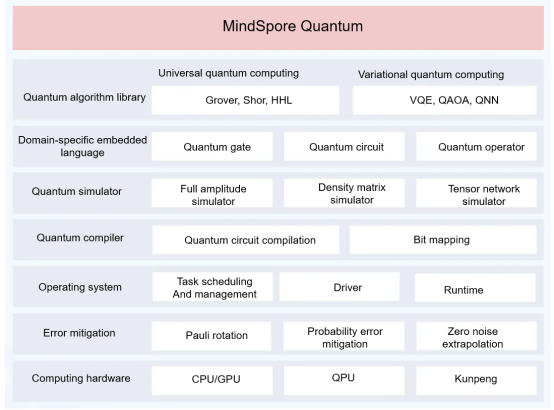
In the rapidly evolving field of quantum computing, designing efficient variational quantum algorithms is essential. MindSpore Quantum, built on the robust MindSpore open-source deep learning framework, excels in the design and training of these algorithms on both CPU and GPU platforms. This enables researchers to efficiently develop and optimize variational quantum algorithms with exceptional performance.
2 MindSpore Quantum Features
● Supports multiple quantum computing data types and provides a powerful parameter resolver.
● Introduces a state vector simulator and density matrix simulator at the circuit simulation backend to simulate a pure or mixed state quantum system.
● Provides multiple tools, such as gradient of variational quantum algorithm (VQA), circuit Ansatz library, and quantum algorithm subroutine.
● Showcases powerful capabilities in various application scenarios, including quantum neural network (QNN), quantum approximate optimization algorithm (QAOA), variational quantum eigensolver (VQE), data re-uploading classifier, Q-GAN, reinforcement learning, and singular value decomposition (QSVD).
● Introduces QuPack, a meticulously crafted quantum computing acceleration engine, to improve computing efficiency.
● Continuously develops related capabilities on real quantum hardware.
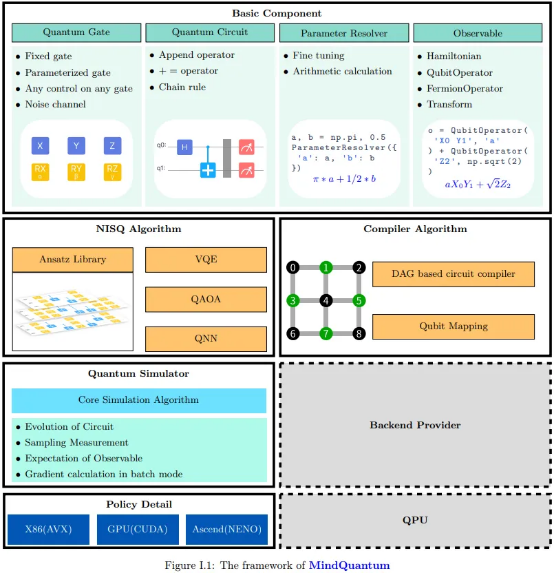
MindSpore Quantum supports multiple quantum computing data types and provides a powerful parameter resolver, including parameter generator and parser, for quantum algorithms. The quantum gate module in the framework, including fixed gate and parameterized gate, allows users to construct quantum circuits. In addition, the framework provides various observables, such as Hamiltonian, QubitOperator, FermionOperator, and Transform, to further improve the functionality and flexibility of quantum computing.
At the circuit simulation backend, MindSpore Quantum introduces a state vector simulator and density matrix simulator to process the simulation of pure and mixed states. In particular, the quantum channel-based noise simulator can simulate noise more realistically through quantum channels and the Channel Adder module, greatly improving simulation accuracy and reliability. Channel Adder allows users to quickly customize noise models to meet different experiment requirements.
To help users better use VQAs, MindSpore Quantum provides multiple tools. For example, the gradient calculation tool of VQA may provide accurate gradient calculation in a plurality of application scenarios. In addition, the framework includes an Ansatz circuit library specially designed for VQAs and a quantum algorithm subroutine for simplified quantum algorithm implementation.
MindSpore Quantum excels not only in fundamental quantum computing research but also showcases its powerful capabilities across various application scenarios. These include QNN, QAOA, VQE, data re-uploading classifier, Q-GAN, reinforcement learning, and QSVD. These diverse applications highlight the broad applicability of MindSpore Quantum in quantum computing research. By supporting multiple research directions, it significantly expands the scope of quantum computing applications.
To further improve computing efficiency and performance, MindSpore Quantum introduces QuPack which can significantly improve the simulation speed of VQE, QAOA, and tensor network.
MindSpore Quantum's capabilities on real quantum hardware are still evolving. Currently, it offers some basic functions, including quantum circuit compilation and optimization, and quantum mapping. These foundational features pave the way for future applications on quantum hardware.
3 Performance Tests
3.1 Random Circuit Task
The white paper compares the performance of MindSpore Quantum with other quantum computing frameworks, highlighting its significant advantages in random quantum circuit simulation tasks.
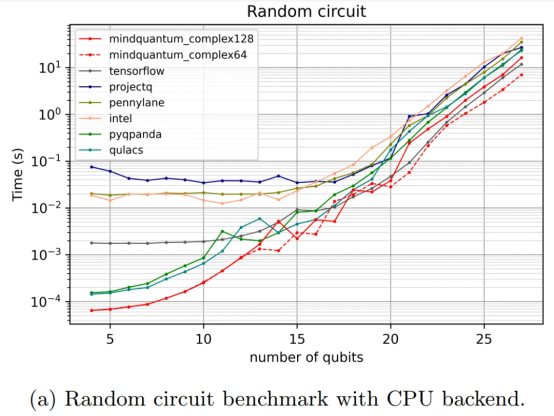
For small bit scenarios, MindSpore Quantum's low API call overhead is a key factor in its superior performance. For larger bit scenarios, its use of multi-thread parallel computing and efficient implementation of fundamental quantum gates ensures excellent performance.
3.2 QAOA Task
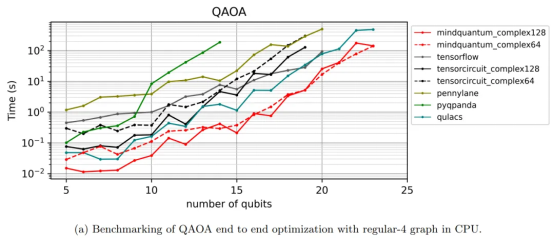
In addition, the performance of each framework in QAOA tasks is also tested. The results show that the performance of MindSpore Quantum is at least one order of magnitude faster than that other frameworks. This is mainly due to the in-depth optimization of MindSpore Quantum in gradient calculation of parameterized quantum circuit and efficient implementation of circuit evolution.
If you have used MindSpore Quantum in your research, you can quote the white paper in the following way:
BibTeX format:
@misc{xu2024mindspore,
      title={MindSpore Quantum: A User-Friendly, High-Performance, and AI-Compatible Quantum Computing Framework},
      author={Xusheng Xu and Jiangyu Cui and Zidong Cui and Runhong He and Qingyu Li and Xiaowei Li and Yanling Lin and Jiale Liu and Wuxin Liu and Jiale Lu and others},
      year={2024},
      eprint={2406.17248},
      archivePrefix={arXiv},
      primaryClass={quant-ph},
      url={https://arxiv.org/abs/2406.17248},
}
4 Acknowledgement
MindSpore Quantum provides a powerful and efficient platform for quantum computing researchers. For more information about MindSpore Quantum, you can read the white paper at https://arxiv.org/pdf/2406.17248. And if you are interested in MindSpore Quantum, you can visit the Gitee code repository of the project at https://gitee.com/mindspore/mindquantum. MindSpore Quantum is released using Apache License 2.0 and can be used for academic research and commercial purposes for free.
Thanks for participating in the MindSpore Quantum project:
Xusheng Xu,1 Jiangyu Cui,1 Zidong Cui,2 Runhong He,3 Qingyu Li,2 Xiaowei Li,4 Yanling Lin,5 Jiale Liu,5 Wuxin Liu,1 Jiale Lu,1 Maolin Luo,1 Chufan Lyu,2 Shijie Pan,1 Mosharev Pavel,1 Runqiu Shu,6 Jialiang Tang,7 Ruoqian Xu,7 Shu Xu,1 Kang Yang,1 Fan Yu,1 Qingguo Zeng,4 Haiying Zhao,1 Qiang Zheng,5 Junyuan Zhou,1 Xu Zhou,8 Yikang Zhu,5 Zuoheng Zou,1 Abolfazl Bayat,2,9 Xi Cao,10, 9 Wei Cui,6 Zhendong Li,11 Guilu Long,12, 13 Zhaofeng
Su,5 Xiaoting Wang,2, 9 Zizhu Wang,2, 9 Shijie Wei,12 Re-Bing Wu,10 Pan Zhang,14 and Man-Hong Yung1, 4, 15, 16, 17
1 MindSpore Quantum Special Interest Group
2 Institute of Fundamental and Frontier Sciences, University of Electronic Science and Technology of China, Chengdu 610051, China
3 State Key Laboratory of Computer Science, Institute of Software Chinese Academy of Sciences, Beijing 100190
4 Institute for Quantum Science and Engineering, Southern University of Science and Technology, Shenzhen 518055, China
5 School of Computer Science and Technology, University of Science and Technology of China, Hefei 230027, China
6 School of Automation Science and Engineering, South China University of Technology, Guangzhou 510641, China
7 Department of Physical Chemistry, University of the Basque Country UPV/EHU, Apartado 644, 48080 Bilbao, Spain
8 School of Physics and Astronomy, Sun Yat-sen University, Zhuhai 519082, China
9 Key Laboratory of Quantum Physics and Photonic Quantum Information, Ministry of Education, University of Electronic Science and Technology of China, Chengdu 611731, China
10 Department of Automation, Tsinghua University, Beijing 100084, China
11 Key Laboratory of Theoretical and Computational Photochemistry, Ministry of Education,
College of Chemistry, Beijing Normal University, Beijing 100875, China
12 Beijing Academy of Quantum Information Sciences, Beijing 100193, People’s Republic of China
13 State Key Laboratory of Low-Dimensional Quantum Physics and Department of Physics,
Tsinghua University, Beijing 100084, People’s Republic of China
14 CAS Key Laboratory for Theoretical Physics, Institute of Theoretical Physics, Chinese Academy of Sciences, Beijing 100190, China
15 Shenzhen International Quantum Academy, Shenzhen 518048, China
16 Guangdong Provincial Key Laboratory of Quantum Science and Engineering, Southern University of Science and Technology, Shenzhen 518055, China
17 Shenzhen Key Laboratory of Quantum Science and Engineering, Southern University of Science and Technology, Shenzhen 518055, China