
Paper on MindSpore-based AI + Fluid Simulation Foundation Model Published in Top Journal
Paper on MindSpore-based AI + Fluid Simulation Foundation Model Published in Top Journal
The research paper on the rapid prediction scheme for flow fields over 2D supercritical airfoils has been accepted by a top fluid dynamics journal, Physics of Fluids. The scheme is developed by the COMAC Shanghai Aircraft Design and Research Institute based on the Ascend-based MindSpore AI framework, and has incubated the DongFang·YuFeng model, significantly accelerating the design of large aircraft. A team led by Dong Bin, a teacher from the School of Mathematical Sciences of Peking University, also participated in the model incubation.
The model was released by Academician Wu Guanghui, chief scientist of COMAC, at the World Artificial Intelligence Conference (WAIC) held in September 2022. Related code and part of the datasets have been open-sourced in the MindSpore Flow (mindscience) code repository at Gitee[1].
DongFang·YuFeng, built based on the ultimate computing power of Ascend AI, is an advanced AI simulation model designed to predict flow fields over large aircraft' airfoils with high accuracy and efficiency. With the support of the MindSpore fluid simulation suite, it has significantly enhanced its ability to simulate complex flows. Compared to traditional methods, it has reduced the time required for a single simulation to less than 1/20 and achieved an average error rate of only 0.01%, meeting industry-level standards.
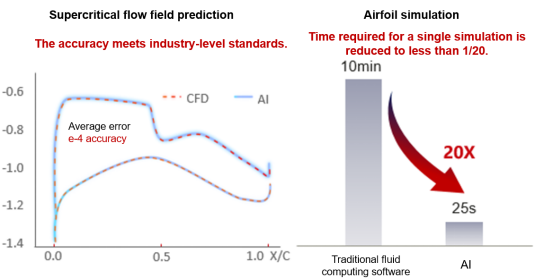
Prediction result of surface pressure coefficients of DongFang·YuFeng and simulation efficiency comparison
In aircraft design, the drag distribution of wings accounts for approximately 52% of the overall flight drag. As a result, the shape design of wings is of utmost importance in enhancing the overall flight performance of aircraft. To achieve efficient and accurate flow field prediction for supercritical airfoils using AI, we must address several technical challenges, including uneven airfoil grid density, difficult flow feature extraction, significant changes in flow features due to variations in aerodynamic parameters or airfoil shapes, and the difficulty of prediction in shock wave areas where flow fields change sharply.
We have designed a technical path[2] based on the AI model to address the aforementioned technical challenges, which involves constructing end-to-end mappings between airfoil geometries and corresponding flow fields in different flow states. The key steps include:
(1) Design an efficient AI data conversion tool to extract features from complex boundaries and non-standard data of flow fields over airfoils, as shown in the data preprocessing module in the figure below. In this case, the regularized AI tensor data is generated by the grid transformation program of the curvilinear coordinate system, and geometric coding is used to enhance the extraction of complex geometric boundary features.
(2) Use a neural network model to map the airfoil configurations and physical parameters of flow fields under different flow states, as shown in ViT-based encoder-decoder in the figure below. The input of the model is airfoil geometry information and aerodynamic parameters generated after coordinate transformation. The output of the model is the physical parameter information of flow fields, such as the velocity and pressure.
(3) Train the network weights using the multi-level wavelet transform loss function. Perform further decomposition and learning on abrupt high-frequency signals in flow fields, so as to improve the prediction accuracy in areas (such as shock waves) where flow fields change sharply, as shown in the module of the loss function.
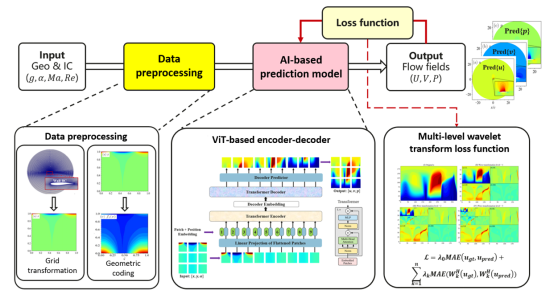
Technical path of the DongFang·YuFeng model
By utilizing the wall distance-related geometric coding technology and the multi-level wavelet transform loss function, DongFang·YuFeng is able to reduce the flow field-wide prediction error by 20% while increasing the flow field prediction error near shock wave areas by 50%, based on the aforementioned methods, strategies, and optimization plans. The following figure shows the reconstructed flow fields.
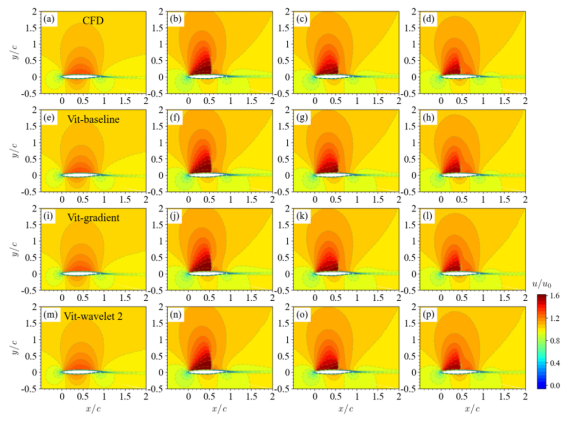
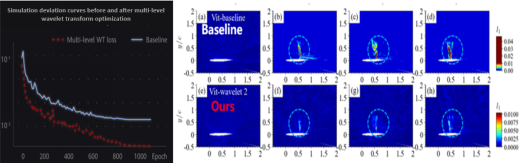
Error correction effect after using the multi-level wavelet transform deviation
This model can also serve as a pre-trained model for flow fields over 2D airfoils. Ablation experiments show that, following rapid fine-tuning and generalization of new airfoils and working conditions, only minute-level transfer learning of data from 1 to 5 flow fields is required to achieve an inference and prediction accuracy of 1e-4.
As the starting point of 2D supercritical airfoil research, DongFang·YuFeng features high accuracy and high efficiency. It lays a solid technical groundwork for future exploration into 3D airfoils. In the future, AI will further empower basic research on fluid dynamics, meteorology, and oceans, showing great application prospects.
References
[2]Prediction of transonic flow over supercritical airfoils using geometric-encoding and deep-learning strategies. ZW Deng et al. Physics of Fluids 35, 075146 (2023)