Idea Sharing | Unsteady Aerodynamic Surrogate Model and Its Application in High-Lift Devices
Idea Sharing | Unsteady Aerodynamic Surrogate Model and Its Application in High-Lift Devices
Background
Traditional aerodynamic design focuses on the aerodynamic characteristics of aircraft in stable airflow, in other words, the aerodynamic force in a steady state. However, turbulence, vortex, and the movements of aircraft components cause the unsteady aerodynamic force to change over time, exhibiting strong nonlinearity and hysteresis. This has become a crucial area of study in fluid dynamics research. Early unsteady aerodynamic modeling was mainly based on simplified potential flow theory and vortex theory, and involved derivations of experience formulas, ordinary differential equations or integral equations.
With a large amount of fluid data being recorded, data-driven models like the ONERA and Beddoes-Leishman models have emerged as a replacement for the traditional unsteady surrogate model. These models incorporate experimental data to correct the traditional model in scenarios where the focus is on stall at high angles of attack (AOA).
From a data perspective, the step output of unsteady aerodynamic at a specific moment is related to historical values, and the response of the flow field is both lagging and nonlinear. Based on this, researchers have proposed an autoregressive-exogenous model (ARX) that incorporates external input to predict the response of aerodynamic forces in the time domain. Cowan et al. have successfully applied the autoregressive moving average (ARMA) model to predict the flutter boundary of a wing and the aeroelastic response of a hypersonic aircraft. Zhang et al. used an ARX-based aeroelastic model to study unsteady aeroelastic deformation of a wing at a high AOA. They also proposed aeroelastic modeling and optimization techniques for arbitrary structures. The fitting capability of neural networks is also applied in unsteady aerodynamics. For regular changes, Tatar et al. used Fourier transform and multilayer perceptron (MLP) to extract and fit the damping derivative in high AOA aircraft motions, establishing the aeroelastic reduced order model (ROM).
In the time domain, researchers are exploring the use of historical output of a surrogate model within a certain period of time as part of the input vector to predict unsteady aerodynamic force over time. The traditional neural network's feed-forward back propagation (FFBP) algorithm is still used during parameter training, with the parameter gradient being recursively calculated layer by layer based on the neural network structure.
Several studies have been conducted in this area. Winter et al. used a local neural-fuzzy model (NFM) with output feedback to perform multi-step forward prediction. They also employed an MLP neural network as a posteriori method to perform nonlinear quasi-static correction on the time series response of NFM, which enabled nonlinear identification of aerodynamic forces. Kou et al. opted for radial basis functions as the activation functions and built a ROM model using the radial basis function neural network (RBFNN). They improved the model's generalization capability by utilizing a validation set. Ren et al. further refined this approach and developed an airfoil buffet control system based on RBFNN.
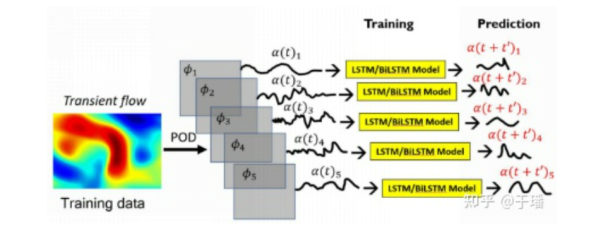
The LSTM neural network offers unique advantages in processing long-term historical information and is widely used in various applications such as handwriting recognition, natural speech recognition, and text-to-speech conversion. In the field of unsteady aerodynamic surrogate modeling, Mohan et al. proposed a reduced-order modeling method for turbulence control using Proper Orthogonal Decomposition (POD) and LSTM network. This method shows great potential in modeling turbulent transient dynamics. Furthermore, in aeroelastic modeling, unlike traditional ROM, the LSTM network does not require delay order selection and is suitable for simulating the unsteady aerodynamic delay effect. It accurately captures the aeroelastic system dynamics of oscillating airfoil under different flow and structural parameters.
Turbulence Prediction Method Based on LSTM
The activation process of the two-dimensional high-lift device is shown in the following figure.

We propose using the history of the aerodynamic coefficient, the deflection angle and deflection speed of the control airfoil as the model input, and using the lift coefficient and static stability margin as the neural network output. Based on this, we come up with the following structure of the unsteady aerodynamic surrogate model:
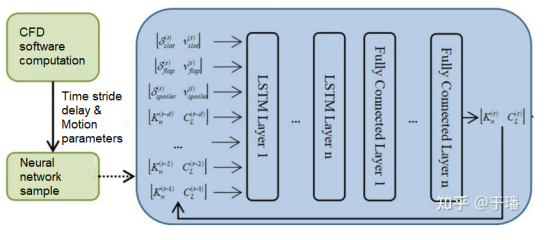
LSTM Neural Network Surrogate Model
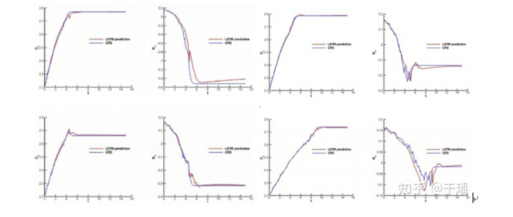
After adjusting hyperparameters such as the LSTM layer and fully connected layer, an optimal performing neural network model is obtained. The following figure displays prediction results for four calculation examples in the test set. During the activation of the high-lift device, the surrogate model accurately predicts the aerodynamic coefficient.
References
[1]https://arxiv.org/search/physics?searchtype=author&query=Mohan,+A+T